

2026-10-14 14:13:01
A German clinical study shows that using an advanced bipolar vessel sealing system in post-bariatric abdominoplasty was associated with a reduction in overall complications from 55% to 19.6%, along with an approximately 30-minute reduction in operative time.
Addressing the Complications of Post-Bariatric Abdominoplasty
As the number of bariatric procedures continues to rise worldwide, many patients experience significant excess skin following substantial weight loss. Abdominoplasty has become an important option for improving physical function and quality of life in these patients.
However, patients undergoing abdominoplasty after bariatric surgery may face a 60–87% higher risk of complications than the general population. Seroma, surgical site infection, hematoma, and wound dehiscence remain significant clinical challenges.
Improving surgical efficiency while reducing postoperative complications is therefore an important objective in this patient population.
Clinical Research at a Leading German University Hospital
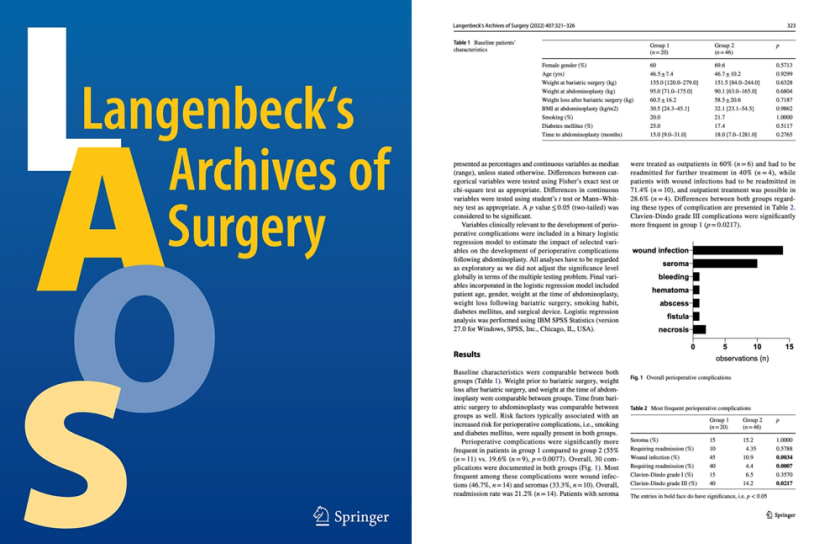
The study was published in Langenbeck's Archives of Surgery in 2022 (407:321–326), a long-established surgical journal founded in 1872 and affiliated with the German Society of Surgery.
The research team included specialists from the Department of General, Visceral and Transplant Surgery at University Hospital Münster (Universitätsklinikum Münster, UKM), working in collaboration with bariatric and plastic surgery specialists from the Knappschaft healthcare group.
· First author: Sonia Radunz — Department of General, Visceral and Transplant Surgery, University Hospital Münster.
· Corresponding author: Markus Utech — Department of General and Visceral Surgery, Knappschaft Hospital Gelsenkirchen.
· Senior author: Andreas Pascher — Department of General, Visceral and Transplant Surgery, University Hospital Münster, with extensive expertise in organ transplantation.

Advanced bipolar significantly reduces complications.
The study included 66 patients who underwent abdominoplasty following bariatric surgery. Patients were divided into two groups according to the year of surgery:
· Group 1: Conventional electrosurgery (n = 20) — Skin-flap dissection was performed using conventional electrosurgical techniques.
· Group 2: Advanced bipolar energy (n = 46) — An advanced bipolar vessel sealing system was used.
No statistically significant differences were reported between the groups in baseline clinical characteristics. Established risk factors, including smoking and diabetes, were similarly distributed. Pre-bariatric body weight, the magnitude of weight loss, body weight and BMI at abdominoplasty, and the interval between the two procedures also showed no significant between-group differences.
The study reported a reduction in the overall complication rate from 55% in the conventional electrosurgery group to 19.6% in the advanced bipolar group.
Across both groups, 30 complication events were recorded. Surgical site infections were the most common, accounting for 46.7% (14 events), followed by seromas at 33.3% (10 events). The overall readmission rate was 21.2%.
The most notable difference was observed in surgical site infections:
· Surgical site infection rate: decreased from 45% to 10.9%.
· Readmission rate: decreased from 40% to 4.4%.
These findings suggest that advanced bipolar vessel sealing may offer meaningful benefits in the management of patients undergoing abdominoplasty after bariatric surgery.
Source: Radunz S, et al. Langenbecks Arch Surg. 2022.
Why Reduced Operative Time?
During conventional electrosurgical dissection, large veins crossing the fascia may require additional exposure and manual ligation to achieve hemostasis, adding procedural steps and time.
An advanced bipolar vessel sealing system designed to seal vessels up to 7 mm in diameter may simplify these steps by enabling vessel sealing and cutting within a single workflow, potentially reducing the need for separate ligation.
Supporting evidence from other surgical fields is also encouraging. A meta-analysis of 26 studies reported that bipolar vessel sealing systems reduced mean operative time by 28% compared with conventional hemostatic techniques.
Advanced Bipolar Energy as an Independent Factor Associated with Fewer Complications
Multivariable logistic regression analysis identified the use of an advanced bipolar vessel sealing system as the only independent factor associated with a lower risk of perioperative complications following abdominoplasty:
OR = 0.108; 95% CI: 0.022–0.523; p = 0.006.
Smoking and body weight at the time of abdominoplasty were independently associated with an increased risk of complications. In contrast, the magnitude of weight loss following bariatric surgery was not independently associated with complication risk.
The study also found no statistically significant association between age and complications. This is consistent with findings reported by Couto and colleagues, suggesting that, with appropriate patient selection, abdominoplasty may be performed safely across different age groups.
Source: Radunz S, et al. Langenbecks Arch Surg. 2022.
Clinical Value of Advanced Bipolar Energy Platforms
The technology used in this study highlights several important capabilities of advanced bipolar energy devices:
· Intelligent tissue sensing to support responsive energy delivery.
· Vessel sealing capability up to 7 mm, depending on the device's validated specifications.
· Controlled energy delivery designed to support consistent tissue sealing and cutting.
These capabilities reflect an important direction in the development of surgical energy technology. Advanced bipolar devices are used across multiple surgical specialties, including general, colorectal, urological, and gynecological surgery, where they may help streamline surgical workflows and support effective hemostasis.
By potentially reducing operative time and postoperative complications, advanced bipolar energy systems may also help reduce the need for additional outpatient interventions and hospital readmissions. Shorter procedures may reduce anesthesia exposure and improve operating-room efficiency, potentially allowing healthcare teams to make better use of limited surgical resources.
Saints Sages: Engineering for Clinical Needs
As an innovator in surgical energy devices, Saints Sages developed its advanced bipolar energy platform around key technological considerations relevant to clinical practice, including intelligent tissue feedback, controlled energy delivery, and instrument designs tailored to different surgical requirements.
The SanPulse advanced bipolar instrument portfolio is designed to address the needs of multiple surgical specialties, including general surgery, bariatric surgery, gynecology, and urology. By offering different instrument configurations for different anatomical spaces, tissue characteristics, and procedural requirements, Saints Sages aims to provide surgeons with adaptable energy solutions for a wide range of surgical applications.
*Reference: Radunz S, et al. Langenbecks Arch Surg. 2022;407:321–326.
 Official LinkedIn


